
The Morning Alignment: win the day before the inbox does
The first war of every day is for your attention, and the inbox usually wins it before your feet hit the floor. The Morning Alignment is how I take it back: stillness first, then the board, then one priority, before any screen gets a vote. Fifteen minutes, same order, every day.
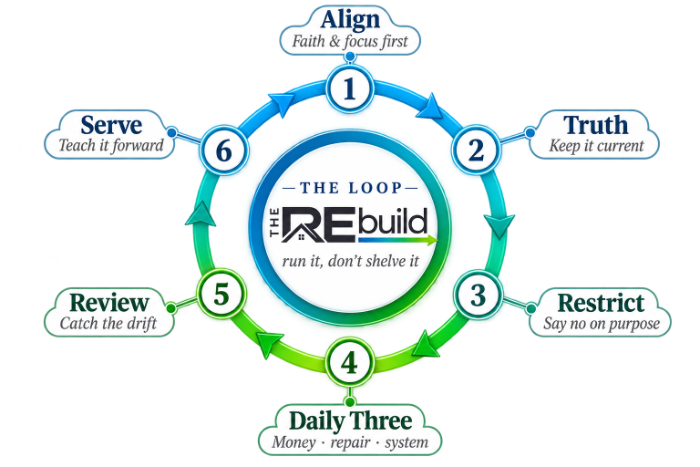
From The REbuild — see all 456 pages →
Stillness looks different for different people. For me it is prayer; for you it might be meditation, breath, or silence with coffee. The mechanism is the same: you cannot aim a mind that is already reacting. Five minutes of quiet is not a luxury, it is the calibration step every other decision leans on.
Then the board: yesterday’s Daily Three read back, the open loops, the one number that worries me. And then the single priority, written as a sentence, that would make today a win even if everything else slips. One, not three. The inbox gets opened only after the priority exists, so the day starts on offense.
None of this requires a 5 a.m. alarm or an ice bath. It requires sequence. Stillness, board, priority, then the world. Most people reverse it and spend the whole day renting their attention back from other people’s emergencies.
You cannot aim a mind that is already reacting.
Why the first hour decides the other fifteen
If the first inputs of your day are messages, problems, and a bank balance, you have handed the day’s agenda to whoever emailed you last. The morning alignment is not a wellness ritual. It is a decision-making practice that runs before anyone else gets a vote.
Ten minutes is enough. I have run it in a truck, in a hotel room, and on the floor of a half-built storage office. The point is not the setting, it is that the sequence happens before the reacting starts.
The sequence
The morning decides the tone of the day. Everything after it is either that tone or a recovery from losing it.
What goes wrong
The most common failure is length. People build a ninety-minute routine, sustain it for eleven days, and then quit entirely because a hard morning makes it impossible. A practice you can complete on your worst day is worth more than a perfect one you abandon.
The second failure is doing it after the phone. Once you have read one message you are negotiating with someone else’s priority, and the alignment becomes a nice thing you did rather than the thing that set the day.
Why it compounds
Any single morning of this is unremarkable. Sixty of them changes what you say yes to, because you stop discovering your priorities at nine in the morning and start arriving with them already decided. That is the entire mechanism, and it is available tomorrow.
Adapting it to a real life
I have run this in a hotel room the morning of a restaurant opening and in a truck outside a storage facility waiting for a contractor. The sequence bends; the order does not. Prayer, loops, the Daily Three, the sentence, the guarded block. On a compressed morning each step gets ninety seconds and the whole thing takes eight minutes, and eight honest minutes beats a skipped hour.
The one adaptation I recommend for anyone with kids: run it before they are awake, even if that costs you sleep, or run it deliberately alongside them. My children have watched me do this, and that turned out to matter more than the productivity did.