
The 80/20 Stack: five twenties equal a hundred
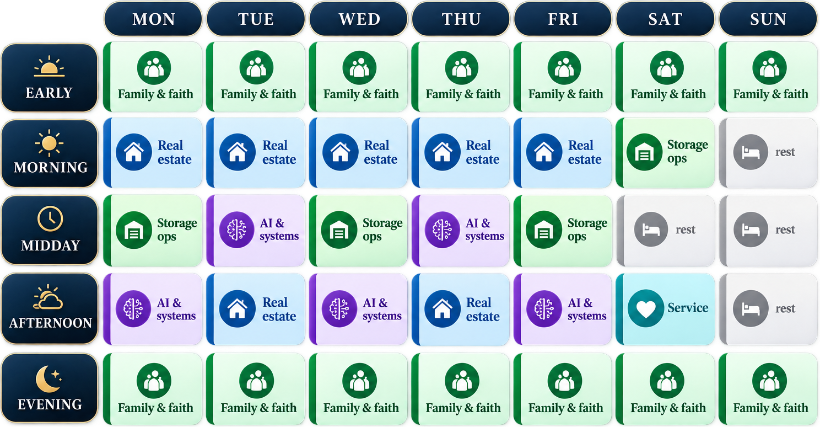
The old rule says eighty percent of results come from twenty percent of effort. Everyone quotes it; almost nobody follows it to the interesting conclusion. If twenty percent of your effort produces an outcome that is passable, as good as most people’s hundred, then you do not have one career’s worth of hours. You have five twenties.
From The REbuild — see all 456 pages →
That is the 80/20 Stack: five major things run in parallel, each fed by its leveraged twenty. Mine have been design leadership, storage, rentals and flips, restaurants, and this education work, and the honest secret is that none of them gets my hundred. They get the twenty that moves the needle, and systems and people cover the rest.
The word passable does strategic work here. Passable is not sloppy; it means good enough to win at the standard the situation actually requires. Your eighty percent may be someone else’s hundred. Reserve your true hundred for the few moments that deserve it, closing the deal, the crisis, the person you love, and stop spending it on polish nobody asked for.
And what are the twenties for? Not just income. One twenty can be your faith, your kids’ team, the volunteering that keeps you human. The stack is not a greed engine; it is proof you are not capped at one salary, one title, one identity.
You do not have one career’s worth of hours. You have five twenties.
My version is different from the one you have heard
The usual reading of the 80/20 rule is defensive: find the twenty percent that matters and cut the rest. Mine is offensive. If twenty percent of your effort produces eighty percent of a result, and eighty percent of a result is as good as most people’s hundred, then you have four more twenties available. You can run five things at once, each at a level that passes, instead of one thing at a level nobody asked for.
What the five lanes were for me
Design work paid the bills for years while storage, restaurants, and acquisitions each ran on a twenty. That is how I stacked a full career on top of building companies without any of them collapsing: none of them got my whole day, and none of them needed it. Later, one of the twenties became time with my kids, and another became the work that eventually replaced the salary.
Passable in five lanes beats perfect in one, because the salary cap only applies to people running one lane.
Where people get it wrong
They read this as permission to be mediocre at everything. It is the opposite. Each twenty has to actually clear the bar, and clearing the bar with a fifth of your effort requires knowing precisely which actions matter, which is harder than working long hours on all of them. Effort is easy. Selection is the skill.
The second mistake is stacking five lanes that all draw on the same hour. Two businesses that both need you at 9am on Monday are one lane with a scheduling problem. Real lanes are separable in time.
The point of it
This is not a productivity trick. It is a way to reject the idea that your capacity is one job’s worth of hours and one salary’s worth of income. Five twenties is how a designer became an operator without quitting first, and it is how you can live abroad on one passable lane if that is the life you actually want.
What a twenty looks like on the calendar
Concretely, a twenty is about a ninety-minute block, protected, three or four days a week. That is roughly six hours, and six focused hours a week is enough to run a self-storage facility remotely, keep a small consulting practice alive, or write a book. It is not enough to do any of them perfectly, which is the entire point.
Stack five of those and you have used thirty hours of a week with real intent, and you still have not touched the evenings. This is the arithmetic behind the 90-Day Month: three blocks a day is fifteen a week, and fifteen protected blocks is more focused output than most people produce in a month of open-ended availability.