
The 90-Day Month: three days of output in one
Time is not the problem; fragmentation is. A scattered workday is twelve fragments, and every switch between them pays a toll in warm-up, cool-down, and the static of an open inbox. Stack the same hours into three protected focus blocks, one named outcome each, and you will ship what used to take three scattered days, before dinner.
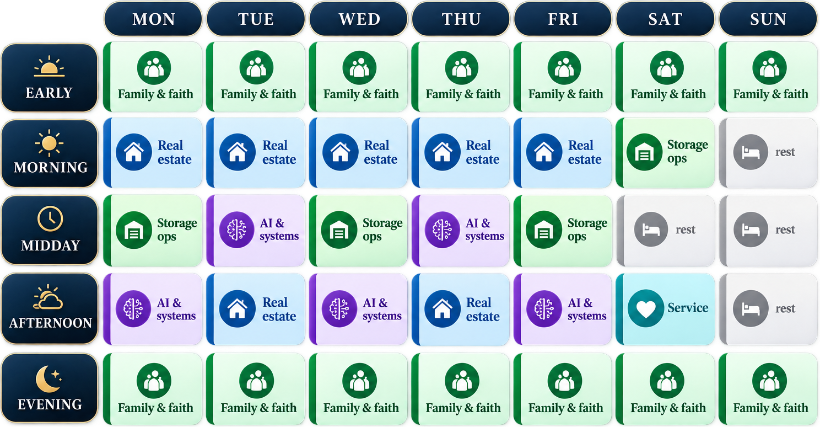
From The REbuild — see all 456 pages →
This is not hustle mythology; it is arithmetic about switching costs. The block is where the money moves, the repair moves, and the system moves actually happen. Everything else, the meetings, the feeds, the “quick questions,” is commentary between blocks, and commentary is where days go to die.
Remote work quietly rewrote the ceiling here. The operator who runs blocks from a home office does not just match the office worker who commutes between interruptions; they lap them. It is how I stacked design careers before real estate, and it is how one person can run a portfolio, a brand, and a family calendar that actually gets kept.
Run the stacked day five times a week and the month deepens into what I call the 90-Day Month: ninety days of output in thirty on the calendar. Guard the blocks like appointments with a lender, because they are worth more.
The month does not get longer. It gets deeper.
Where three days inside one day comes from
A calendar day has twenty-four hours for everyone. What differs is how many uninterrupted blocks you get out of it. Most people work in one long smear of partial attention and produce maybe two hours of real output. Three protected blocks of deep work, with a defined outcome each, produce what a scattered week produces.
That is the whole claim. Not more hours, more finished blocks. Three of them a day, thirty days a month, is ninety units of real progress where the average is closer to thirty.
What makes a block count
You do not need more hours. You need fewer interruptions inside the hours you already have.
How it stacks with the 80/20 rule
The two ideas are the same engine. If eighty percent of the result comes from twenty percent of the effort, then a protected block spent on the right twenty percent is worth several unprotected days spent on everything else. The 90-day month is the scheduling mechanism; the 80/20 rule is how you choose what goes in the block.
This is exactly how I stacked design work with businesses for years, and how I run multiple companies now. Not by working every waking hour, but by refusing to let the important blocks get colonized by other people’s urgency.
The honest caveat
Nobody sustains three deep blocks every single day forever. Family, travel, and emergencies happen. Aim for three, accept two on hard days, and count the month rather than the day. Seventy blocks in a month is still more than most people manage in a quarter.
What it costs, honestly
Three protected blocks a day means somebody is not getting immediate access to me for most of the morning. That has a cost, and pretending otherwise is how people abandon this in week two. I answer slower than I used to. I have missed calls that mattered. What I gained was the ability to finish things, and finished things are what people actually judged me on in the end.
The way I make it survivable is by being explicit rather than mysterious. My team knows the blocks exist, knows when the reactive window is, and knows the one channel that always reaches me for genuine emergencies. Almost nothing qualifies, and everyone is calmer for it. An unavailable person who explained the rules is easier to work with than an available person who is half present.
And I count months, not days. Travel happens, family happens, a property floods. Seventy good blocks in a month while living an actual life beats a fantasy of ninety that collapses the first time reality arrives.