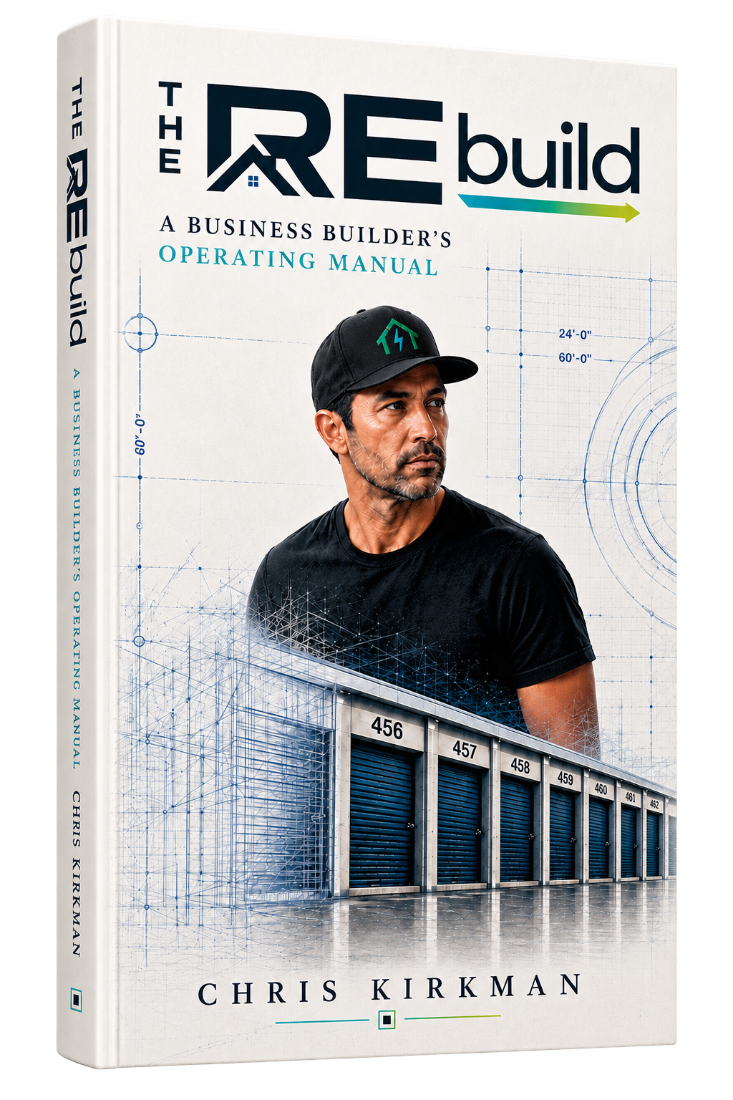
What 456 means to me
The complete edition of The REbuild is 456 pages. That began as a page count, but the more I looked at it the more it read like a summary of the whole book.
Four. Five. Six. The numbers do not repeat and they do not move backward. They climb, one step at a time. That is how rebuilding actually works. When your life, business, finances, health, family, or confidence has been shaken, you rarely escape through one dramatic breakthrough. There is no elevator from broken to rebuilt. You find the first solid rung, put your weight on it, and reach for the next.
Why some people call 456 an angel number
If you search the meaning of 456 you will quickly find sites describing it as an “angel number.” In modern numerology, angel numbers are sequences some people read as spiritual messages or encouragement. Numerology has roots in several ancient cultures, but the popular phrase itself is recent, commonly associated with a 2005 book on the subject, and there is no single accepted interpretation. Meanings shift depending on the writer and the system.
The common modern reading is that four is structure and foundation, five is change and freedom, six is responsibility and service, and the ascending order is gradual progress. I understand why that resonates. It is hopeful, and it is built on the idea that one stage prepares you for the next.
But as a Christian I approach it differently. I do not look to 456 to predict my future, and I do not believe seeing 4:56 on a clock guarantees money or an easier season. My direction comes from God, Scripture, prayer, wise counsel, and the responsibility to act on what I already know is right. At the same time I do not need to pretend symbolism is meaningless. A sunrise, a doorway, a seed, a staircase, or a number can remind us of something true without becoming an object of worship or a method of fortune-telling.
I do not treat 456 as a code that controls my life. I treat it as a memorable symbol pointing back to principles I already believe.
Four: build a foundation strong enough to hold you
Four carries foundations, order, discipline, construction. Even visually it feels stable: four corners, four directions, four seasons, a structure square and level. That fits the first requirement of rebuilding, which is establishing what is true.
You cannot rebuild your finances without opening the statements. You cannot rebuild a company without understanding the numbers. You cannot repair a relationship while refusing to acknowledge what happened. You cannot rebuild your health without confronting your habits. A real foundation begins with an honest inventory.
The foundation is rarely glamorous. It is the budget, the phone call, the calendar, the operating procedure, the morning routine, the apology, the boundary, and the promise you finally keep to yourself. That is why the book is full of formulas, worksheets, scripts, and checklists. When my own life came apart I did not need another person shouting motivation from a stage. I needed a checklist for Tuesday morning.
Five: accept that rebuilding requires change
Five is movement, transition, adaptation, and it is the uncomfortable part. Most of us say we want a new result while quietly hoping to preserve every old habit, assumption, and routine. Rebuilding is not putting every broken piece back exactly where it was. Sometimes the old structure failed because it could no longer support the life being built inside it.
Change may mean simplifying, selling something, ending something, learning something, asking for help, or admitting that an identity you worked hard to protect no longer fits. That does not make the past a mistake. A structure can serve you for one season and still need to change for the next.
This is where most rebuilds stall. People mistake familiarity for safety, rebuild the same structure with the same weaknesses, and wonder why it falls again. The goal is not chaos, it is intelligent adaptation: keep what is true, repair what can be repaired, release what needs releasing, and build differently where experience taught you better.
Six: rebuild for something larger than yourself
Six is responsibility, care, family, harmony, service, and for me it is the reason to rebuild at all. Success is not proving I can recover. It is being more present for my children, more responsible with what God entrusted to me, and more useful to someone standing where I once stood.
I wrote the book because somebody once handed me the first rung. A mentor took a call he did not have to take, and that conversation changed what my family’s life could look like. This is my attempt to hand that rung back.
Foundation without change becomes rigidity. Change without responsibility becomes instability. Foundation that survives change and matures into service becomes something worth building.
The Christian meaning I find in 4:5-6
The Bible does not teach that 456 carries a hidden universal message, and I would never tell someone God guarantees an outcome because a number keeps appearing. What the page count does invite me to notice is the number written as a Scripture reference: 4:5-6. Several passages at that chapter and verse speak directly to rebuilding.
Those passages do not turn 456 into a Christian formula. They do something better. They point toward endurance, wisdom, prayer, service, grace, and light in darkness.
The equation hidden inside the book
There is one connection I find hard to ignore: 4 + 5 + 6 = 15, and the book contains exactly fifteen parts. Four is the foundation, five is the change, six is the responsibility and service that should grow out of it. Together those three stages equal the whole structure.
I do not offer that as proof of a supernatural prediction. I see it as alignment. The page count, the ascending sequence, the fifteen-part structure, and the message all tell the same story. You do not rebuild everything at once. You establish what can hold you. You change what can no longer stay the same. You use what you build to care for something larger than yourself.
Build the foundation. Embrace the change. Serve what matters. That is the 4-5-6 REbuild sequence.
The book ends on page 456. Your REbuild begins on page 457.
A book about action should not end with the reader merely feeling inspired. The final page is not a finish line, it is a handoff. Page 457 is not printed, because page 457 belongs to you.
It is the call you make after closing the cover. The number you finally face, the habit you begin, the conversation you stop avoiding, the application you submit, the offer you make, the person you forgive, the system you build, or the person you decide to help. That is the difference between information and transformation. Information ends on the page; transformation continues through action.
The complete edition contains 456 pages, 15 parts, 31 formulas, and 53 worksheets. None of those numbers matter unless the material helps somebody move. For some people 456 will stay an angel number. For others it is an interesting sequence. For me it has become a symbol of something both practical and spiritual: God can bring light from darkness, and I still have to take the next faithful step.
I do not need to see the entire staircase. I need enough faith to take the next rung. Four. Five. Six. The book ends here. Your REbuild begins on the next page.