
Square feet per capita screens a market. It cannot pick one.
Ask anyone in storage about a market and you will hear the ratio: square foot per capita, measured against a national average somewhere in the sevens. It is a useful number, and it has probably caused more bad purchases than any other statistic in the industry, because people treat a screening metric like a verdict.
From The REbuild — see all 456 pages →
Three corrections
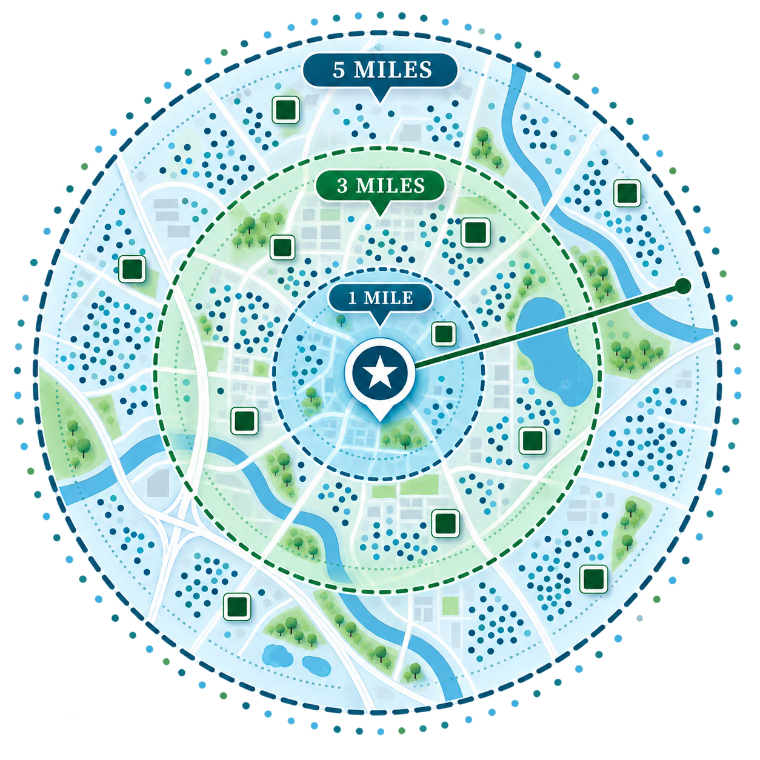
First, draw the trade area before you calculate anything. Storage demand is hyper-local, usually a ring of three to five miles, and the boundary is behavioral, not geometric: rivers, highways, and commute patterns bend it. Second, use rentable square feet, never gross building area; hallways and offices do not rent. Third, remember the ratio says nothing about price. A market can look oversupplied and still hold strong rents because the supply is old, climate-uncontrolled, or badly run.
What finishes the job
Drive every major approach to the property. Map every competitor, then mystery shop them by unit type and write down real quoted rates, not website teasers. Ask sellers for customer-origin data. Check the pipeline for planned and under-construction supply, because the ratio you bought is not the ratio you will operate in. When the ring, the rents, and the pipeline all agree with the ratio, you have a market. When they disagree, believe the shoe leather.
I keep a field note on this in the book right where market underwriting begins, because it is the correction I make most often on hot seats.
The saturation test in one number
Take the rentable storage square footage inside a trade area and divide by the people who live there. That is square feet per capita, and it is the fastest honest read on whether a market has room for more supply or is already choking on it. Nationally the figure sits somewhere around seven to eight; individual markets range from three to fifteen.
How to compute it without buying a report
Square feet per person tells you whether the market can absorb you. It cannot tell you whether you will be any good.
What the number does not tell you
It says nothing about quality. A market at nine where every competitor is a 1980s first-generation facility with no climate control and a phone that goes to voicemail is a market with room for one modern operator. A market at five where three institutional players just opened is not. Read the number, then shop the competitors by unit type and see who answers the phone.
It also moves. Population growth in a ring can turn eight into six in five years without a single new facility. Population decline does the reverse. The trend is the second half of the analysis.
Why this is on page one of my underwriting
Because everything else in a storage deal can be fixed by operations except supply. You can raise rates, tighten collections, add ancillary revenue, and answer the phone. You cannot make three new competitors un-open. Supply per person is the risk you cannot operate your way out of, so it is the one I check before I spend an hour on anything else.
Two markets, same number, opposite decisions
I looked at two trade areas within a year that both computed to roughly eight square feet per person. In the first, the competitors were institutional, recently built, climate-controlled, and answered the phone on the second ring. In the second, they were three first-generation facilities with roll-up doors, no website, and a manager who worked Tuesday through Thursday. I passed on the first and bought in the second, and the second has been one of the better decisions I have made.
The number was identical. What differed was who I would be competing against and whether there was operational room to win. Supply per person tells you whether the market can absorb another operator. Shopping the competitors tells you whether that operator can be you.
Do this before your next deal
Spend the twenty minutes. Draw the ring, count the square feet, pull the population, and then drive the competitors and call each one as a customer. You will know more about the market than most of the people bidding against you, and it costs nothing but an afternoon.