
One bad thing does not get to become everything
At some point, life will interrupt the day you thought you were going to have.
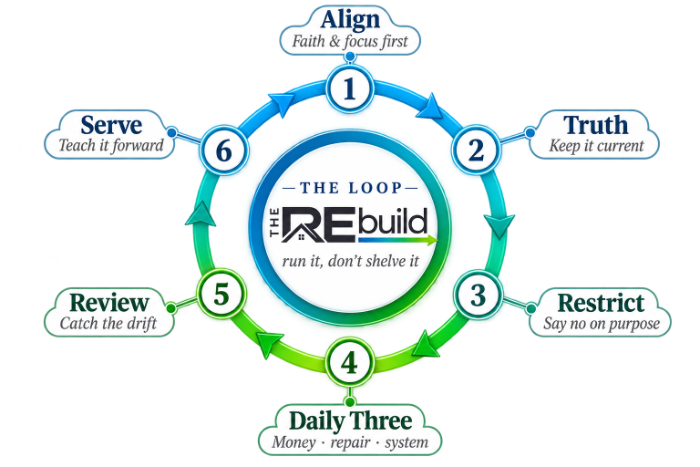
From The REbuild — see all 456 pages →
A payment will not arrive. A deal will fall apart. A key employee will call out. The repair will cost more than you expected. Someone you trusted will disappoint you. The phone will ring with news you were not prepared to hear.
The event may take only a few minutes, but the mind can turn it into an entire future.
One problem becomes, “Nothing ever works out for me.” One rejection becomes, “I am never going to get another opportunity.” One unexpected expense becomes, “I am about to lose everything.” One painful conversation becomes, “This relationship can never be repaired.”
That is how a hard moment becomes an overwhelming life. The problem does not stay in its lane. It crosses every border, occupies every thought, and begins speaking for things it knows nothing about.
Here is something I have had to learn, and relearn: one bad thing deserves to be acknowledged. It does not deserve to become everything.
The problem is real. The catastrophe story may not be.
I am not suggesting that we pretend everything is fine.
Gratitude is not denial. It is not spiritual makeup applied over an open wound. It does not ask us to call a betrayal good, act as though a financial loss does not matter, or smile through grief so other people feel more comfortable.
Some things really are painful. Some seasons really are unfair. Some losses cannot be repaired by a positive slogan.
But pain and gratitude are not enemies. They can occupy the same room. You can be disappointed and still recognize that your future is not over. You can grieve someone you love and still thank God for every year you had with them. You can be afraid of what happens next and still notice who is standing beside you now. You can say, “This hurts,” without adding, “Therefore, my whole life is ruined.”
Gratitude does not erase the problem. It keeps the problem from erasing everything else.
Do not give one moment authority over your whole life
Imagine waking up to a phone that is 2 percent charged.
Your attention locks onto the red battery icon. You start hunting for a charger, checking outlets, calculating how many minutes you have left. The phone still holds your photographs, contacts, calendar, notes, music, and years of memories, but all you can see is the one blinking warning.
That is what stress does to the mind. It takes one urgent fact and enlarges it until the rest of life disappears behind it.
The warning may be legitimate. The phone really does need power. But the warning is not the whole phone, just as today’s problem is not your whole life. The goal is not to ignore the warning. The goal is to respond to it without forgetting everything that is still working.
The 1-3-1 gratitude reset
When something goes wrong, I use a simple pattern that stops a difficult moment from becoming an emotional landslide: one hard fact, three things still standing, one faithful next step.
1. Name one hard fact
Describe what happened without turning it into a prophecy. “The client chose someone else,” not “no one values what I do.” “The repair is going to cost $2,400,” not “I will never recover financially.” “We had a painful argument,” not “we always destroy everything.”
Facts help us respond. Catastrophic stories make us surrender. Try saying: this happened, it matters, it is not everything.
2. Name three things still standing
Do not reach for vague positivity. Find three specific truths the problem did not take from you: a person who will answer when you call, a skill you still possess, a lesson the situation revealed, a resource you can use, a responsibility you still have the privilege to carry, a previous hardship you survived, a door that remains open, a simple comfort you would miss if it disappeared tomorrow, the presence of God even when you cannot yet understand His plan.
Specific gratitude works because it gives your mind evidence. It reminds you that the difficult thing is part of the picture, not the entire frame.
3. Take one faithful next step
Gratitude is not where action ends. It is where wiser action begins. Send the email. Make the call. Ask for help. Reschedule the meeting. Apologize for your part. Review the numbers. Rest for one hour. Pray before you respond. Write down the next three options.
You do not have to solve your entire life tonight. You only need to take the next honest step with what is still in your hands.
What this looks like in real life
When a major client walks away
The hard fact: Revenue you expected is no longer coming.
Three things still standing: You still have the ability that won the client in the first place. You now have room to improve the offer. You have people in your network who have not heard from you recently.
The next faithful step: Contact five former clients with a clear, useful offer instead of spending the day refreshing the rejection email.
The lost account is real. The lie is that it was your last possible account.
When the refrigerator fails before the weekend rush
The hard fact: You may lose inventory, time, and money.
Three things still standing: Your team noticed before anyone was harmed. You have suppliers and nearby businesses you can call. The failure exposed a weakness you can prevent from repeating.
The next faithful step: Protect the food, communicate with the team, call for service, and document a backup plan.
Gratitude does not fix the refrigerator. It keeps frustration from breaking the leader too.
When your offer on a property is rejected
The hard fact: This deal will not happen on the terms you proposed.
Three things still standing: Your capital is still available. Your underwriting just got sharper. The relationship with the broker or seller may create another opportunity later.
The next faithful step: Ask what mattered most to the other side, record what you learned, and analyze the next deal.
A rejected offer is not proof that you cannot succeed. Sometimes it is protection from a purchase that only looked like an opportunity.
When the car will not start on an important morning
The hard fact: Your schedule is disrupted and there may be an unexpected bill.
Three things still standing: You found the issue before getting stranded somewhere less safe. You have a phone that can connect you to help. Most of what matters today can be rearranged, even if it is inconvenient.
The next faithful step: Notify the person waiting for you, arrange transportation, and get a diagnosis before assuming the worst.
An inconvenience can ruin the plan without being allowed to ruin the person.
When you do not get the job
The hard fact: You wanted the role and someone else was selected.
Three things still standing: The interview showed which parts of your story resonate. Preparing reminded you how much you have accomplished. Another company may need the exact combination of strengths this one overlooked.
The next faithful step: Ask for feedback, strengthen one weak area, and send the next application before discouragement becomes a hiding place.
One company’s decision is information. It is not a verdict on your value.
When someone you love disappoints you
The hard fact: Trust was damaged and the conversation matters.
Three things still standing: You can choose your response. You can set a boundary without becoming bitter. There may still be history, love, accountability, or wisdom available, even if the relationship must now change.
The next faithful step: Wait until you can speak truth without trying to wound, then have the conversation anger wants you to avoid or destroy.
Gratitude does not require access for people who repeatedly hurt you. Sometimes the gift is clarity. Sometimes it is courage. Sometimes it is the strength to leave peacefully.
When you receive frightening health news
The hard fact: Something serious may be happening, and it deserves careful attention.
Three things still standing: You know more than you knew yesterday. There are qualified people you can ask for help. You have this moment to love, pray, prepare, and decide with the information available.
The next faithful step: Schedule the follow-up, write down your questions, and invite someone trustworthy to walk with you.
This is not the moment for forced positivity. It is the moment for honest courage. Some days gratitude is not a celebration. It is a whisper: God, I do not understand this, but thank You for not leaving me alone in it.
Gratitude is attention with direction
Whatever we repeatedly search for, we get faster at finding.
If we rehearse every offense, inconvenience, and threat, our minds become expert investigators of what is wrong. Even on a good day, we will find evidence for disappointment. But if we practice noticing what remains, we get better at seeing resources, relationships, options, beauty, humor, and grace under pressure.
This does not make us naive. It makes us harder to defeat. A grateful person can still negotiate firmly, end an unhealthy relationship, make an emergency plan, cut an expense, admit a mistake, or grieve deeply. Gratitude does not remove discernment. It protects discernment from panic.
Panic says, do something now so this feeling stops. Gratitude says, pause, see the whole picture, then do the next right thing.
Start with small gratitude
There will be days when naming three blessings feels easy. There will also be days when even one feels out of reach. On those days, make gratitude smaller and more specific.
Thank God for the chair holding you up. For the glass of water within reach. For the friend whose name came to mind. For the breath you did not have to earn. For the fact that you have survived every day that once convinced you that you would not. For one more morning in which a different decision can still be made.
Small gratitude is not shallow gratitude. A single match is small too, and it can still push back a roomful of darkness.
The life you notice becomes the life you experience
Most of us are waiting to feel grateful after life improves. After the debt is paid. After the business stabilizes. After the relationship heals. After the diagnosis changes. After the door finally opens.
But gratitude was never meant to be a prize we collect when the struggle is over. It is part of how we walk through the struggle without losing ourselves.
You may not be able to choose what arrived today. You can choose whether it gets every room in your mind. Let the problem be real, but keep it inside its actual borders. Let grief speak, but do not let it speak alone. Let fear warn you, but do not let it lead you. Let gratitude widen the frame until you can see the trouble, the help, the lesson, the love, the options, and God’s presence all at once.
The next time life goes off script, remember: one hard fact, three things still standing, one faithful next step.
Then breathe. Give thanks for what the problem did not take. And keep rebuilding.