Cap rates and the only two ways to win
A cap rate is just next year’s net operating income divided by the price. Simple division, endlessly abused. What it tells you is how the market currently prices a dollar of this property’s income; what it cannot tell you is how you will make money. There are exactly two ways: grow the NOI, or sell at a lower cap rate than you bought.
From The REbuild — see all 456 pages →
NOI growth is in your control. Raise revenue with rate discipline and occupancy, cut expenses a professional operator should never have tolerated, add income the last owner ignored. Every dollar of NOI you create is worth that dollar divided by the market cap rate, which is why a fifty-thousand-dollar income improvement can be worth close to a million at a five cap.
Cap-rate compression is weather. When rates fall and money chases the asset class, the same income sells for more. It is a real force and it has made people rich, but you cannot schedule it, and deals underwritten to require it are prayers wearing spreadsheets.
So underwrite like this: the deal must work at today’s cap rate on the NOI you can force. Compression, if it comes, is dessert. The operators who survived every cycle are the ones who never needed the weather to cooperate.
NOI growth is in your control. Compression is weather.
Only one of them is in your control
A commercial property gains value two ways: the net operating income grows, or the cap rate compresses. You control the first one. You have no influence whatsoever over the second, and yet most of the enthusiasm in this business is quietly a bet on it.
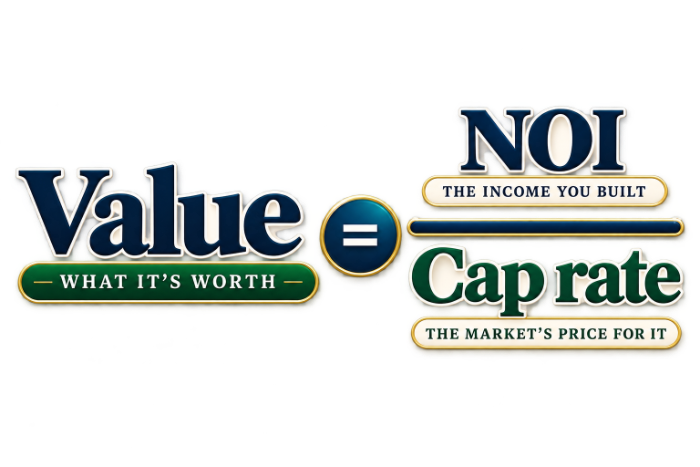
Value equals NOI divided by cap rate. That single relationship explains every good and bad outcome I have had in this asset class.
The number that makes this concrete
At a six percent cap rate, one dollar of recurring annual NOI is worth roughly sixteen dollars of value. That is why a two hundred dollar per month rate increase across fifty units is not a two hundred dollar decision, it is a change in the asset’s worth measured in six figures. And it is why an unnecessary expense line is far more expensive than it looks on the P&L.
Grow the NOI. The value follows, whether or not the market cooperates.
What happens when you bet on cap rates
In this cycle I have watched properties refuse to sell because rents had not risen and rates were so high that no valuation worked. Nothing about those buildings changed. The denominator moved, and everyone who had underwritten on cap-rate compression discovered they had bought a hope rather than an asset.
The operators who did fine were the ones who had spent the prior years growing the numerator. Their value did not depend on somebody else’s appetite.
The discipline
Buy for the numerator. If the denominator moves your way, that is a gift. If it moves against you and your NOI still grew, you still made money, which is the only version of this business that survives a full cycle.
How this changes what you buy
Once you accept that only the numerator is yours, your buy box changes. You stop looking for the cheapest cap rate and start looking for the biggest honest gap between what a property earns today and what a professional operator could make it earn. That gap is usually somebody’s neglect: legacy rates never raised, delinquency never enforced, ancillary revenue never offered, expenses never bid out.
It also changes what you are willing to pay for a well-run asset. If a seller has already captured everything, your return has to come from debt terms and time, and that is a much thinner story to tell a partner. There is nothing wrong with owning a clean, professionally operated property. Just be honest that you bought income rather than an opportunity, and price it that way.
The practical version: for every deal, write the specific NOI moves with dollar amounts and dates before you sign. If you cannot name three, you are betting on the denominator, whether or not you admit it in the memo.