
The five doors of storage demand
People do not rent storage because they love paying for a second garage. They rent it when life changes shape. The industry calls them the five doors: death, divorce, dislocation, downsizing, and disaster, with a sixth quiet cousin, the declutter. Every door is a life transition, and transitions do not check the Fed funds rate first.
Every one of them opens on a deadline somebody else set. Walk down them in order.
An estate has to be emptied on a deadline nobody chose. The family is out of state, the house is selling, and the contents need somewhere to sit while five siblings decide. Nobody negotiates the rate.
One household becomes two. Half the furniture has nowhere to go for a while, and "a while" is however long the lawyers take. This tenant is not price shopping on move-in day.
A job transfer, a military posting, a lease that ended before the next one started. The move is real and the timeline is not flexible, so the unit gets rented the same week.
A bigger house becomes a smaller one, or a retiree moves in with family. Forty years of accumulation does not fit, and the decision about what to keep gets deferred into a 10x10.
A fire, a flood, a burst pipe, a hurricane. The contents that survived need shelter while the property gets rebuilt, and the insurance adjuster is often the one writing the check.
Why the doors matter more than the market
Most people underwrite storage by looking at rates and occupancy in a market report. That tells you what happened. The doors tell you why it happened, and whether it will keep happening. A trade area with an aging population, a military base, a hospital system, and a steady flow of job transfers has four doors propped open permanently. A trade area whose only demand driver was a construction boom has one door, and it closes when the cranes leave.
This is the difference between a facility that holds 90 percent occupancy through a recession and one that empties out the moment the local economy sneezes. Same building, same signage, same software. Different doors.
Reading the doors in a real trade area
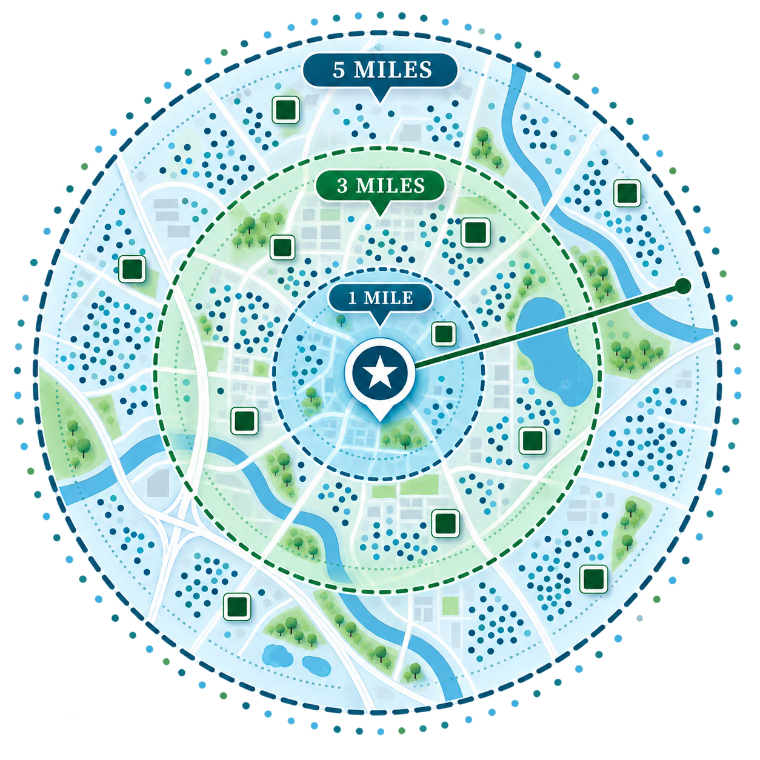
When I screen a market I am not looking for storage demand in the abstract. I am counting the doors, one at a time, inside a three-to-five mile ring. Death: what is the median age, and are there estate attorneys and funeral homes nearby? Divorce: what does the county filing rate look like, and are there apartment complexes absorbing the people who move out? Dislocation: is there a base, a university, a hospital, a large employer that transfers people? Downsizing: are there active-adult communities or a lot of long-tenured owner-occupied homes? Disaster: what does the flood map say, what is the fire risk, and how old is the housing stock?
Five yes answers is a market that will forgive a mistake. One or two yes answers means your occupancy is a bet on one employer or one demographic trend, and you should underwrite it that way.
From The REbuild — see all 456 pages →
The doors decide your marketing, not your slogan
Once you know which doors are open, you know where the calls come from and what the caller needs to hear. Somebody walking through the death door does not want a promotional rate; they want to know you have a unit today, that the gate works at 7pm, and that a stranger will be kind to them on the phone. Somebody walking through the dislocation door is comparing you against two competitors on their phone in a parking lot, so your Google Business Profile, your photos, and your reviews are the entire sales conversation.
You are not selling square footage. You are selling a clean, lit, safe place for a life in motion.
This is also why the missed call is the most expensive thing in a storage business. A tenant mid-transition calls two or three facilities and rents from whoever answers. Not whoever is cheapest, and not whoever has the nicest website. Whoever answers. If your phone rings through to voicemail during business hours, you are handing your competitor a tenant who would have stayed nine months.
The sixth door, and why I do not build on it
There is a sixth door everybody mentions: the declutter. Somebody just has too much stuff and wants a garage they do not have. It is real demand and it fills units, but it is the only door a tenant can close voluntarily. When money gets tight, the declutter tenant sells the jet skis and gives you notice. The other five doors are not optional; the estate still has to be emptied, the divorce still separates a household, the fire still happened.
So I underwrite to the five and let the sixth be upside. If a facility only works because of declutter demand, it is a consumer-discretionary business wearing a real-estate costume.
How to use this on your next deal
Before you look at the rent roll, write the five doors down the left side of a page and put a number, a source, and a sentence next to each one for the specific ring around that specific property. Then look at the rent roll and see whether the tenant mix matches the doors you found. If the seller's occupancy is built on a door you cannot find in the data, you have just discovered why the price looks attractive.
That is the source of the durability everyone praises in this asset class. In good years people move up and store the overflow; in hard years people move down and store what will not fit. The demand walks through a different door, but it keeps walking in, which is why well-run facilities hold occupancy through cycles that bruise other assets.
For an operator the doors are practical, not poetic. They tell you who is calling: someone mid-transition, often stressed, choosing fast from a search on their phone. Answer the phone, be first, be kind, and be findable within a few miles of where they live; storage is hyper-local, and the ring around your facility is the whole market.
They also tell you what you are really selling: not square footage but relief, a clean, lit, safe place for a life in motion. Price for value, run it professionally, and the doors keep opening.
Transitions do not check the Fed funds rate first.