Entity structure, stated plainly
Nobody starts investing because they love paperwork, but entity structure is where asset protection, tax efficiency, and partnerships all meet, so let me state it the way I run it. This is education, not legal advice; build yours with a real estate attorney and CPA.
From The REbuild — see all 456 pages →
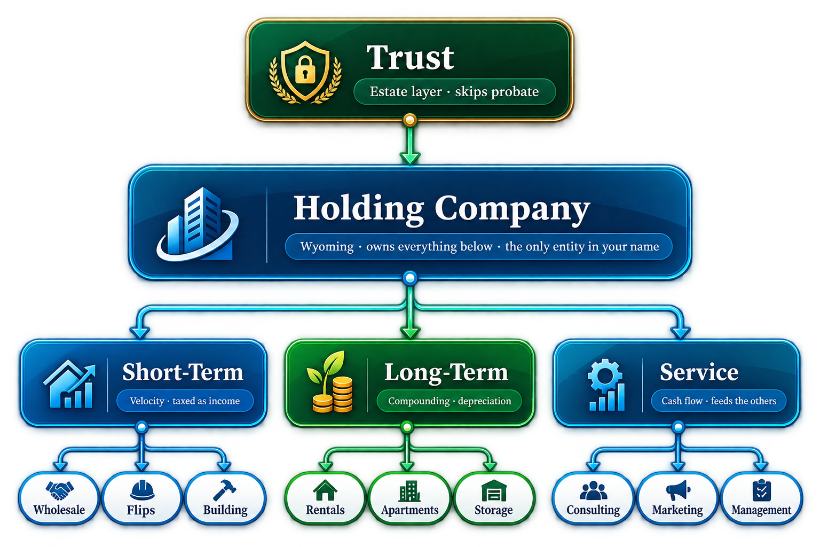
The basic shape: a holding company that owns operating LLCs, with each property or small cluster in its own LLC. The LLC contains liability, a problem at one property should not reach the others, and the holding company gives you one place for ownership, banking relationships, and eventually your kids' names in the estate plan. Single-member LLCs are simple; multi-member LLCs need an operating agreement that actually says who decides what.
Where to form? Your home state is usually right for your first deals, boring but true, because you will register where the property sits anyway. Wyoming earns its fee when privacy, charging-order protection, and a holding-company layer start mattering. Do not buy a Delaware mystique you will never use.
For my Canadian friends: you can absolutely own U.S. real estate, but the structure matters more for you, a GP/LP arrangement formed at home, holding the U.S. LLC, is the classic play to avoid double taxation. Cross-border is exactly where professionals pay for themselves.
The entity is a container, not a strategy. It protects a business that works; it cannot fix one that does not.
What the structure is actually for
An entity structure does three jobs: it separates assets so one problem cannot reach everything, it makes ownership legible to lenders and partners, and it lets your CPA do their job cleanly. It does not make you bulletproof, and it does not replace insurance.
My own shape is simple. A holding company sits on top. Each asset or business sits in its own entity beneath it. Operations that touch the public are separated from the entities that hold title. Everything here is how I do it, not advice for your situation; entity and tax choices depend on your state and facts, so use an attorney and a CPA who do this daily.
Why I default to Wyoming for the holding company
Wyoming has no state income tax, low annual fees, a long track record of LLC-friendly statutes, strong charging-order protection, and no public listing of members. That combination makes it a clean, quiet, inexpensive place for a holding company to exist. The asset-level entities are usually formed or registered where the property is, because that is where the property is.
None of that is a loophole and none of it removes your obligation to register and pay where you actually do business. It is simply an unglamorous default that has worked for me.
A structure you do not respect on paper is a structure a court will not respect either.
Trusts and holding companies, plainly
A holding company owns other companies. Its job is ownership and capital, not operations. A trust is an estate-planning instrument: it holds assets for beneficiaries under terms you set, which matters for what happens after you, and can add a privacy layer while you are here. They solve different problems and people constantly conflate them.
For my Canadian partners
A number of people I work with invest into the States from Canada. The general shape I see used is a Canadian structure that then takes ownership of a US LLC, arranged to avoid the double-taxation trap, with a holding company used for the investments. I am not a cross-border tax professional and this is exactly the place to hire one, but do not let the complexity scare you off. It is a solved problem and plenty of people are doing it.
Review the structure once a year with the same two professionals. Assets get sold, states change their rules, and an entity that made sense at three properties can be dead weight at eight.